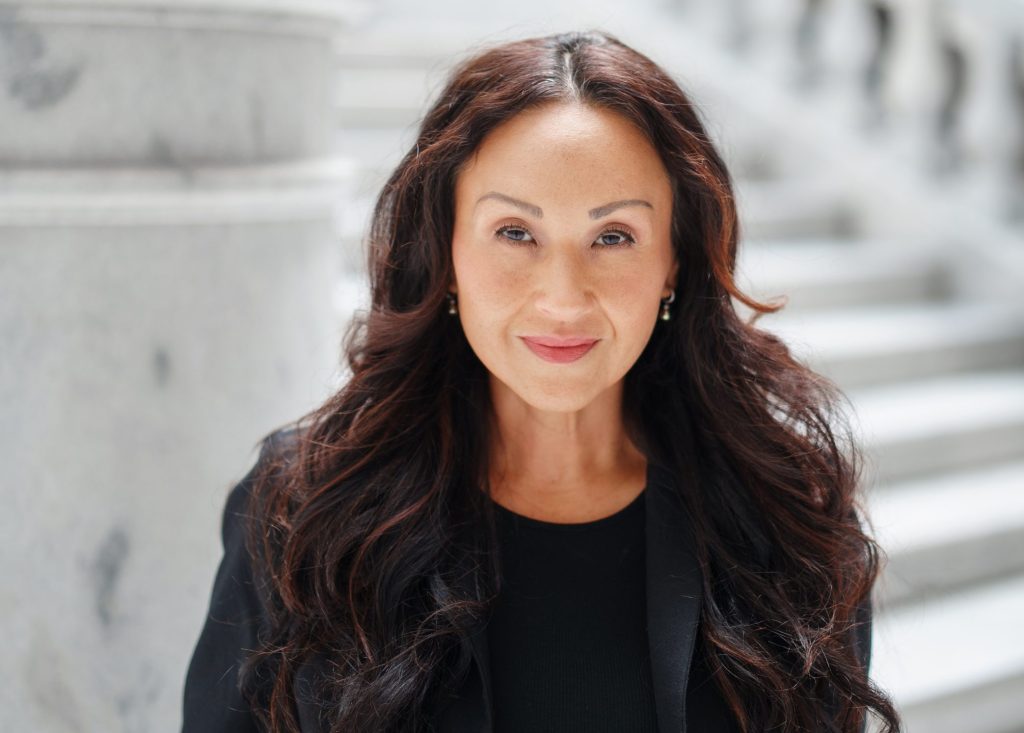
Utah State Bar Emphasizes Need for Lower Court Resources, Willingness to Collaborate with Decisions Impacting the Judiciary

PRESS RELEASE

SALT LAKE CITY, February 3, 2026 โ€“ The Utah State Bar held a press conference on Tuesday at the Utah State Capitol to address a growing number of legislative proposals that would alter how judges are nominated, retained, and insulated from political pressure. The Bar emphasized its willingness to collaborate, advocated for careful study of adding court structures, and responsible use of taxpayer money, particularly in Utahโ€™s strained lower courts, where the majority of Utahns interact with the justice system.

During the press conference, Bar Executive Director Elizabeth Wright and Bar President Kim Cordova explained that the judiciary is an essential branch of government, and must be grounded in constitutional process, evidence-based decision-making, and respect for long-standing safeguards that protect the publicโ€™s right to fair and impartial courts. They both underscored that accountability is strongest when all stakeholders are brought to the table, including judges, attorneys, court administrators, lawmakers, and the public.

They explained processes in a system that the Legislature itself created and has repeatedly reaffirmed, which is recognized as a model for the nation. Every Utah judge is nominated through a nonpartisan commission where the process is merit based, then appointed by the Governor, confirmed by the Utah Senate, and subject to voter retention elections. This structure was deliberately designed to balance accountability with independence, ensuring judges can apply the law without fear of political retaliation or pressure tied to unpopular outcomes.

Emphasis was added that judges are accountable through multiple mechanisms, including public retention elections, appellate review, and ethical oversight.

โ€œWhat accountability does not mean is punishing judges or restructuring the courts because specific rulings are politically unpopular,โ€ said Cordova.

She agreed with the Legislatureโ€™s surmise that population growth is a contributing factor to the need for court expansion, but not at the Supreme Court level. She reiterated that the increase in population is felt most acutely in district, justice and juvenile courts. These lower courts handle the overwhelming majority of cases statewide, yet they continue to operate under severe workload pressures. She highlighted that funding decisions should prioritize relieving these pressures to ensure timely access to justice for Utahns.

Cordova shared her experience as a criminal defense attorney, describing days spent waiting hours for cases to be called in overcrowded courtrooms. She noted that when dockets are overloaded, and staffing is insufficient, cases are delayed, families are disrupted, and individuals in custody often remain incarcerated longer than necessary โ€” not because their cases lack merit, but because the system lacks capacity. These delays carry real human and financial costs for taxpayers and communities alike, she said.

RELATED: Utah State Bar Position On Package of Bills Affecting Utah Courts

Both Bar leaders expressed concern that proposed constitutional amendments affecting judicial nominations and retention would concentrate appointment and removal authority within the political branches, weakening essential checks and balances. Allowing one branch of government to bypass merit-based commissions or trigger special retention mechanisms undermines separation of powers and exposes judges to political retaliation rather than evaluation based on performance and integrity.

Wright also stressed that courts are constitutionally obligated to review whether laws comply with the Utah Constitution. That responsibility is not optional, nor is it a political act. When judges face pressure for fulfilling that duty, it is the public that bears the cost. A justice system cannot function as a meaningful check on government power if judges must weigh legal reasoning against political consequences.

Wright also clarified that the Bar is not a political organization or special-interest group and does not advocate for ideology or outcomes. Its involvement in legislative matters is limited by law and court rule to issues that directly affect the regulation of the practice of law and the functioning and independence of the courts.

โ€œWhen proposals affect how judges are selected, retained, or pressured while on the bench, the Bar has a responsibility to speak on behalf of the justice system and the Utahns it serves,โ€ Wright said.

She expounded further by saying an independent judiciary does not exist to benefit judges. It exists to protect the public by ensuring laws are applied fairly, constitutional rights are upheld, and disputes are resolved based on facts and law. Accountability strengthens institutions when it respects process and constitutional roles; it undermines them when it is used to control or punish.

Cordova added, โ€œAccountability is not about controlling judges. Itโ€™s about controlling ourselves and disagreeing better when the Constitution does its job.โ€

How the Utah State Bar Helps Families: Access, Protection, Education & Accountability

Many people hear โ€œState Barโ€ and think of lawyers, courtrooms, and legal licensing. However, the Utah State Bar serves a much broader purpose. It supports Utah families by helping them access legal services, learn about their rights, protect themselves from dishonest conduct, and address concerns if something goes wrong. Across the state, the Bar works to ensure that the legal system is accessible, trustworthy, and understandable for everyone, regardless of income or background.

When appropriate, the Bar also advocates for a strong and independent judiciary because public protection depends on a court system that is fair, impartial, and free from political or financial influence. When judges can make decisions based solely on the law and the facts, without pressure from outside interests, individuals and families receive equal treatment and predictable justice. The Bar supports policies and public education efforts that reinforce the separation of powers, promote judicial integrity, and ensure that courts remain accessible and accountable. By prioritizing judicial independence, the Bar helps safeguard the rights of all Utahns and reinforces confidence in the courts.

Protecting the integrity of the courts is only one part of the Barโ€™s work to support the public. It also focuses on making sure people can engage with the legal system in practical ways, especially when they are facing challenging life circumstances.

Improving Access to Justice: Legal Help When It Matters Most

Legal issues can affect housing, family stability, employment, finances, and many other areas of life. Unfortunately, some families hesitate to seek legal help because they assume it is too expensive or complicated. The Bar provides alternatives so people can get legal assistance that fits their needs and their budget.

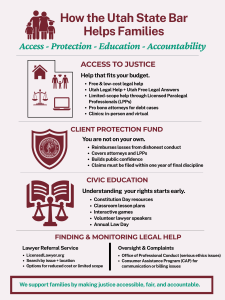
How the Utah State Bar Helps Families

Programs and initiatives include:

    • The Barโ€™s Access to Justice Office provides education and resources for families that qualify for reduced fees, which can be accessed at Utah Legal Help. One particular service offered is limited-scope legal representation under the Pro Se Debt Collection Calendar. Pro bono attorneys represent individuals in need of assistance with debt collection matters. Many of these people appear at their initial hearings self-represented, with little to no understanding of how to defend themselves or their rights. This lack of knowledge frequently leads to default judgments and increased debt amounts. The Access to Justice Office manages this program closely with the courts to ensure these individuals have the opportunity to consult with an attorney, gain clarity about their legal rights, and have a better understanding of their situations.
    • Free and low-cost legal clinics, both in person and virtual. A specific online service is called Utah Free Legal Answers. This program is a virtual legal advice clinic in which qualifying users submit civil legal questions at no costย to be answered by pro bono attorneys.

Question topics include:

  • Family, Divorce, Custody,
  • Housing, Eviction, Homelessness,
  • Consumer Rights, Financial, Work, Employment, Unemployment,
  • Health and Disability, Income Maintenance,
  • Civil Rights,
  • Juvenile and Education Law.
  • Services that offer brief legal advice for people who do not need full representation, such as Licensed Paralegal Professionals (LPP). An LPP can help with certain family law matters (such as temporary separation, divorce, parentage, cohabitant abuse, civil stalking, custody and support, or name changes). They can also assist with landlord/tenant situations involving forcible entry and detainer, and debt collection matters in which the dollar amount at issue does not exceed the statutory limit for small claims cases.

    Because LPPs are not lawyers, they cannot represent you by making arguments to the judge in court. They can help you complete legal forms, review documents, participate in mediation negotiations, prepare settlement agreements, and explain court orders for less than you would pay a lawyer.

The Young Lawyers Division of the Bar sponsors service projects, which include free legal help to various populations. In particular, the division presents Wills for Heroes with estate planning, living wills, and healthcare and financial powers of attorney to first responders (police, firefighters, paramedics, etc.) and their spouses or partners.

These one-day events take place five times a year throughout the state of Utah at a first responder department or community center. Participants are trained and provided with laptop computers that have been preloaded with specialized software that allows volunteer attorneys to take questionnaire information previously completed by the individual and input it to create the legal documents.

These resources support individuals dealing with issues such as divorce, custody, landlord and tenant disputes, consumer problems, and other civil matters. The focus is on making justice available to families at every income level.

However, while improving access to justice is essential, access alone is not enough. Families also need assurance that when they place their trust in a legal professional, that trust will be honored. For that reason, the Bar has systems in place to protect clients if misconduct occurs.

Client Protection Fund: A Safety Net for Victims of Dishonest Conduct

The Utah Supreme Court established the Fund for Client Protection on April 9, 1977, to provide meaningful cost reimbursement to people in the rare cases where a lawyer or LPP mishandled funds or engaged in dishonest conduct.

The fund is designed to:

    • Compensate clients when losses occur due to a legal practitionerโ€™s dishonest actions

    • Promote and preserve public confidence in the legal profession

    • Safeguard individuals who may already be facing stress and difficulty during a legal matter

A claim to the Fund for a loss must meet the following criteria:

    • The loss must be caused by the dishonest conduct of the lawyer or the LPP;

    • The loss must have arisen out of the course of a lawyer/client, LPP/client, or fiduciary relationship between the lawyer or the LPP and the claimant and by reason of that relationship; and

    • The claim to the Fund must be filed within one year after the date of the final order of discipline, the date of death, or the date of the order of disability.

This program reflects the Barโ€™s dedication to protecting the public as well as regulating the legal community. But safeguarding the public is not limited to oversight and complaint resolution. The Bar also strives to strengthen civic knowledge, so Utahns have the tools to participate confidently in their communities and in the legal system.

Civic and Constitutional Education: Learning About Rights and Responsibilities

Supporting civic education for Utah families is something the Bar takes seriously. One example is the Constitution Day webpage, which provides educational tools that introduce constitutional principles in engaging and age-appropriate ways.

Families and educators can access:

    • A downloadable copy of the United States Constitution

    • Interactive educational games suitable for children and families

    • Classroom lesson plans and activities for teachers and homeschool settings

    • Opportunities to invite volunteer lawyers to speak with students about the Constitution and the legal system

The Bar also celebrates Law Day to highlight the rule of law and public understanding of legal rights, government, and justice. These resources help children and adults understand their rights and responsibilities, and how the law affects everyday life.

While civic education lays a strong foundation, families also need support when a legal issue becomes real rather than theoretical. That is why the Bar offers services that guide people from learning about their rights to finding legal professional assistance.

Lawyer Referral Services: Finding the Right Legal Help

When families need an attorney or an LPP, the hardest part is often knowing where to begin. The Bar makes the search easier with LicensedLawyer.org, which connects individuals to licensed professionals based on the type of legal issue, location, and financial situation.

Ethics rules prohibit the Bar from recommending specific attorneys or offering legal advice, but through the referral website, families can:

    • Search for legal professionals by practice area

    • Request help from lawyers who provide limited scope services for those who need assistance with only part of a case

    • Locate practitioners who are open to reduced cost arrangements or alternative payment options

These referral services provide confidence that the lawyer or paralegal practitioner selected is qualified, licensed, and accountable to professional standards. Guiding the public to reputable lawyers is an important step in protecting clients, but equally important is monitoring professional conduct to ensure those lawyers continue to meet ethical and professional expectations.

Office of Professional Conduct: Oversight and Accountability

A healthy legal system depends on strong professional standards. The Bar maintains oversight through two important functions that support the public.

    • The Office of Professional Conduct investigates allegations of serious ethical violations by attorneys or LPPs. The staff thoroughly works to protect the integrity of the profession by prosecuting, where necessary, those individuals who have not satisfied their professional ethical obligations. Additionally, OPC educates licensees of the Bar regarding their professional ethical responsibilities through seminars and discipline notices in theย 
      Utah Bar Journal.

    • The Consumer Assistance Program (CAP) provides help with less serious issues such as communication problems, billing disputes, or difficulty obtaining documents or case information. For instance, CAP may be able to help a consumer get their file, locate their attorney or LPP, resolve a communication problem, and provide some general information about the legal system. CAP can also provide information about lawyers and LPP ethical obligations to the consumer and provide referrals to other resources and agencies.

These resources give families a clear path to address concerns and ensure that legal professionals remain accountable to the standards of their profession. In fact, each resource offered by the Bar fulfills a specific role, but together they form a larger network of support for the community.

What This Means for Utah Families

This comprehensive approach underscores the Barโ€™s dedication to protecting the public and strengthening trust in the justice system. Whether someone is navigating a difficult legal matter, planning for the future, seeking help for a childโ€™s school project, or simply looking for trustworthy legal advice, the Bar offers programs that are designed to serve the public.

Families benefit because:

    • Legal help is available regardless of income

    • Clients are protected if a legal professional acts dishonestly

    • Children and adults have access to high-quality civic and constitutional learning resources

    • People can find licensed legal professionals they can trust

    • There are systems in place to investigate concerns and resolve complaints

The Bar is not only an organization that supports attorneys. It is a resource for Utah families and communities. It promotes access to justice, strengthens public trust, and helps make the legal system understandable and fair for everyone.


AI assisted with the structure of this blog.

AI Tools Utah Lawyers Can Use Today: Practical Recommendations from the Utah State Bar

By Bennett Borden & Victoria Carrington

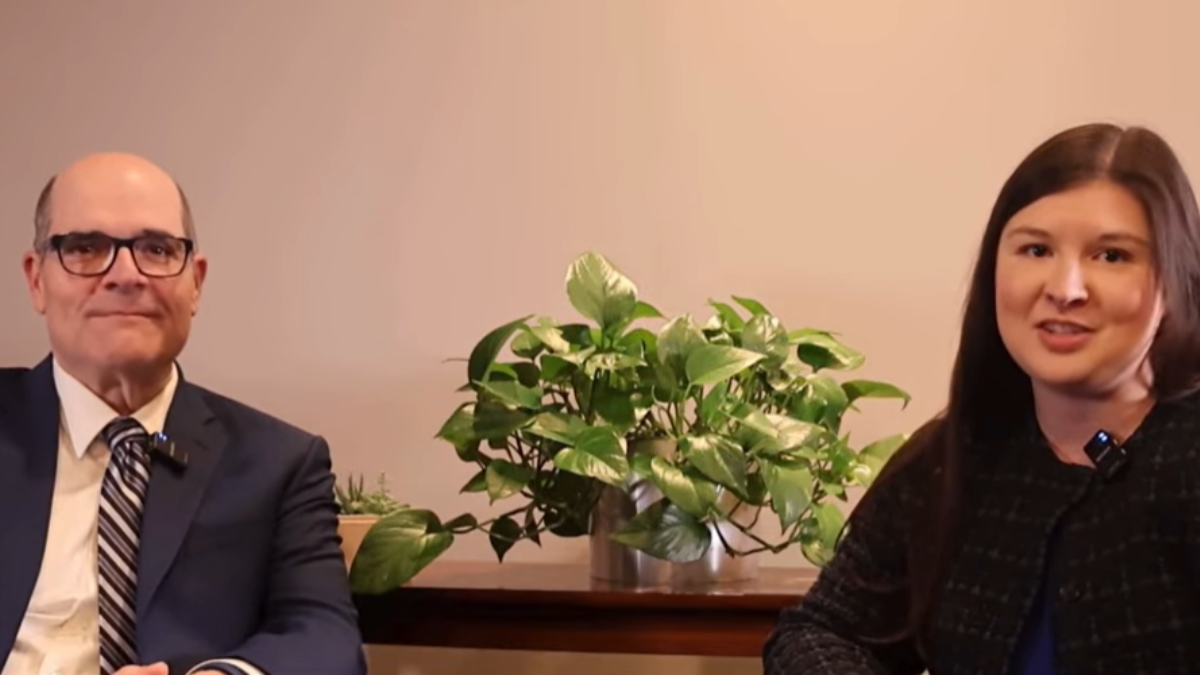
Artificial intelligence is no longer theoretical for the legal profession. It is already reshaping how attorneys research, draft, collaborate, and advise clients. In a recent Utah State Barโ€“hosted discussion, Bennett Borden, founder and CEO of Clarion AI Partners and chair of the Utah State Bar AI Standing Committee, joined Victoria Carrington, a patent attorney and member of the Barโ€™s Innovation in Law Practice Committee, to walk through practical AI tools lawyers can start using right now.

Their message was clear: AI can dramatically improve efficiency and quality, but only when used thoughtfully, securely, and with appropriate professional oversight.

RELATED: Navigating Generative AI in Law: Five Ethical Principles Every Lawyer Should Remember

General-Purpose AI: Powerful Starting Point

ChatGPT by OpenAI

One of the most widely recognized tools discussed was OpenAIโ€™s ChatGPT. At its core, ChatGPT allows users to input natural-language prompts and receive human-like responses in seconds. For lawyers, this makes it a strong ideation and drafting assistant.

Common use cases include:

  • Brainstorming legal arguments or issues
  • Drafting initial outlines or sample language
  • Explaining complex legal concepts in plain English for clients

For attorneys concerned about confidentiality, the paid business version was emphasized as a better fit for legal practice, as it offers enhanced security controls and prevents user data from being used to train public models.

Importantly, the speakers stressed that ChatGPT works best when prompts are detailed and contextualโ€”and that outputs should always be reviewed and refined by the attorney.

Turning Your Documents Into a Knowledge Base

Google NotebookLM

Another standout tool was Googleโ€™s NotebookLM, which allows users to upload documents, links, and materials and then ask targeted questions across that content.

For legal professionals, this opens the door to:

  • Querying deposition transcripts for specific admissions
  • Summarizing case law on targeted legal standards
  • Generating timelines or issue breakdowns
  • Even creating podcast-style audio summaries of dense material

NotebookLM effectively becomes a personalized, searchable knowledge repositoryโ€”particularly useful in litigation-heavy or document-intensive practices.

AI Where Lawyers Already Work

Microsoft Copilot

For firms already embedded in Microsoft 365, Microsoft Copilot offers seamless AI integration across Word, Excel, Outlook, PowerPoint, and Teams.

Practical applications include:

  • Revising document tone and structure directly in Word
  • Summarizing long email threads before meetings
  • Drafting client communications or internal memos
  • Analyzing spreadsheets or preparing presentations

Because Copilot operates inside tools lawyers already use daily, adoption can be faster and less disruptive, especially when paired with the professional licensing version that includes enterprise-grade protections.

Smarter Meetings and Follow-Ups

Zoom AI Companion

Video conferencing is unavoidable in modern legal practice, and Zoomโ€™s AI Companion helps reduce the administrative burden that follows.

Key benefits include:

  • Automatic meeting summaries
  • Action-item tracking
  • Draft follow-up emails
  • Organized notes from whiteboards and discussions

For transactional lawyers managing complex negotiations or multi-party deals, these features can save hours of post-meeting work and reduce the risk of missed details.

Building Advanced Legal Workflows

Notion AI

For attorneys ready to invest in more sophisticated systems, Notion AI offers powerful workflow and knowledge-management capabilities.

Notion AI allows lawyers to:

  • Organize cases, deadlines, documents, and client communications in one system
  • Build repeatable workflows for intake, drafting, and case management
  • Instantly retrieve notes or materials across matters

While Notion has a steeper learning curve, it can deliver significant returns for practices that rely on structured, repeatable processes.

Legal-Specific AI: Purpose-Built for the Law

Beyond general-purpose tools, the speakers highlighted the importance of AI platforms trained specifically on legal content. These include products such as Westlawโ€™s AI tools and LexisNexisโ€™s Lexis+ AI.

For Utah attorneys, Lexis+ AI is particularly notable because:

  • It is trained on authoritative legal databases
  • It reduces the risk of hallucinated citations
  • It supports legal research and drafting with grounded sources
  • Utah State Bar members have access to dedicated resources and discounts

Even with legally trained models, however, the presenters emphasized that AI is not infallible.

RELATED: Lexis+ AI and the Utah State Bar: Building a Trusted Hub for the Future of the Legal Practice

The Most Important Reminder: Lawyers Remain Responsible

A central theme of the discussion was professional responsibility. AI tools can produce work comparable to that of a junior associate, but just like associate work, everything must be reviewed, verified, and quality-controlled by a licensed attorney.

Under the Rules of Professional Conduct, lawyers remain responsible for every filing, communication, and representation made to clients, courts, and opposing counsel, regardless of whether AI assisted in the process.

AI is a powerful assistant, not a substitute for legal judgment.

Curious, Courageous, and Careful

The closing message to Utah lawyers was one of optimism and balance. AI can eliminate much of the repetitive โ€œgrunt workโ€ that has traditionally consumed early legal careers, freeing attorneys to focus on strategy, counseling, and advocacy.

The recommendation was simple:

  • Be curiousโ€”ask the tools how to use them
  • Be courageousโ€”experiment responsibly
  • Put guardrails in placeโ€”and always review the work

More educational content is forthcoming, and attorneys are encouraged to monitor the Utah State Barโ€™s AI resources page and reach out to the AI Committee or the Innovation and Law Practice Committee with questions.

AI is already changing how law is practiced in Utah. With the right tools and mindset, lawyers can ensure it changes the profession for the better.


This blog was written with AI assistance from the transcript of the video discussion produced by Bennett Borden and Victoria Carrington.

Utah Judiciary to Host Court Connect Town Hall in Salt Lake City

PRESS RELEASE

Salt Lake City, Utah โ€” The Utah Judiciary invites Salt Lake County residents to attend a Court Connect town hall on Wednesday, January 14, 2026, from 6:00-8:00 p.m. at the Matheson Courthouse in Salt Lake City. 

Court Connect is a statewide initiative aimed at strengthening public trust in the courts, expanding access to justice, and increasing awareness of court resources and services. This free, public event offers community members a chance to engage directly with Judiciary representatives in an informal, welcoming setting. 

These town halls are designed to open doors and build stronger connections between the courts and the communities they serve. They offer the public an opportunity to learn more about the role of the Judiciary, how the courts operate, and how the judicial branch fits into the broader system of government. 

What to Expect: 

Attendees will have the opportunity to: 

โ— Better understand the role of the courts in Utahโ€™s justice system 

โ— Ask questions and connect directly with Judiciary representatives 

โ— Discover how to access justice services, including self-help resources and online filing systems

โ— Learn about court resources available in their community 

โ— Meet judges and court personnel in a less formal setting 

These town halls mark the first step in an ongoing effort to create opportunities for the public and community partners to engage directly with the Judiciary. Court Connect events are open to everyone โ€“ individual community members, civic organizations, and anyone interested in learning more about Utahโ€™s Judiciary.

Event Details: 

โ— What: Court Connect Town Hall 

โ— When: Wednesday, January 14, 2026, 6:00-8:00 p.m. 

โ— Where: Matheson Courthouse, 450 South State Street, Salt Lake City, UT 84111

# # #

Tania Mashburn
She/Her/Hers
Director of Communications
801-712-4545
taniam@utcourts.gov

Lexis+ AI and the Utah State Bar: Building a Trusted Hub for the Future of Legal Practice

Generative artificial intelligence is no longer a distant concept in the legal profession; it is an active force reshaping how lawyers research, draft, analyze, and serve clients. Recognizing this shift, the Utah State Bar has approved LexisNexis as its trusted AI partner, bringing Lexis+ AIยฎ to Utah attorneys as part of a broader commitment to innovation and professional excellence.

This partnership was announced at the Fall Forum and represents more than access to a new technology. It reflects a strategic investment in helping licensees work smarter, stay competitive, and confidently navigate an evolving legal landscape.

As part of this initiative, the Bar launched a dedicated AI resource page, which is designed to serve as a centralized hub for understanding generative AI. The page offers curated tools, educational materials, and practical insights that help lawyers move beyond experimentation and toward responsible, effective adoption of AI. (Access the AI resource page through your Practice Portal.)

Rather than leaving attorneys to evaluate AI tools on their own, the resource page provides guidance grounded in professional standards, ethics, and real-world legal workflows. It is a space where lawyers can explore emerging technology with confidence, knowing the tools highlighted are built specifically for the legal profession.

Additionally, the Bar’s AI Standing Committee and Innovation in Law Practice Committee have collaborated to provide information specifically for Utah lawyers. Below is a video from Nick Hafen, the chair of the innovation committee, who provides guidance on precautions to take when using AI.

Why Lexis+ AI Matters for Todayโ€™s Legal Practice

The approval of LexisNexis as the Barโ€™s trusted AI partner ensures that attorneys have access to AI solutions developed with legal accuracy, reliability, and confidentiality as core priorities. As AI becomes increasingly central to legal work, trusted technology is no longer optional.

Lexis+ AI supports attorneys by:

  • Streamlining legal research and document review
  • Generating strong first drafts of legal documents
  • Providing fast, clear answers to complex legal questions
  • Grounding results in authoritative, trusted legal content

These capabilities allow lawyers to spend less time on repetitive tasks and more time applying judgment, strategy, and advocacy for their clients.

What Sets Lexis+ AI Apart

Lexis+ AI functions as a legal research assistant purpose-built for attorneys, not a general consumer AI tool adapted for law. Key advantages include:

  • Research in seconds
    Lawyers can receive clear summaries, answers, and case insights quicklyโ€”always tied to authoritative sources that can be reviewed and verified.
  • Smarter drafting
    The platform helps generate polished first drafts with linked citations, making it easier to confirm accuracy and refine work product.
  • Built for lawyers
    Guardrails reduce errors, help prevent hallucinations, and ensure outputs remain grounded in real law, not speculation.
  • Client-safe by design
    User prompts remain private and are not used to train external AI models, supporting confidentiality and ethical compliance.
  • A competitive edge
    By working faster without sacrificing accuracy, attorneys can keep pace with the professionโ€™s technological evolution while maintaining high standards of legal practice.

Empowering Lawyers to Stay Ahead

The Barโ€™s partnership with LexisNexis underscores a forward-looking approach to supporting its licensees. By pairing Lexis+ AI with a dedicated AI resource page, the Bar is giving attorneys not just access to technology, but the context, education, and trust framework needed to use it responsibly and effectively.

For lawyers navigating increasing client expectations, tighter timelines, and growing information complexity, tools like Lexis+ AI can be a meaningful advantage when implemented thoughtfully and with professional safeguards in place.

Another video done collaboratively with the Bar’s AI committee and innovation committee features helpful generative AI tools and tips from AI Committee Chair Bennett Borden and innovation committee member, Victoria Carrington. Watch it to get their expertise recommendations from the tools they use in their own practices.

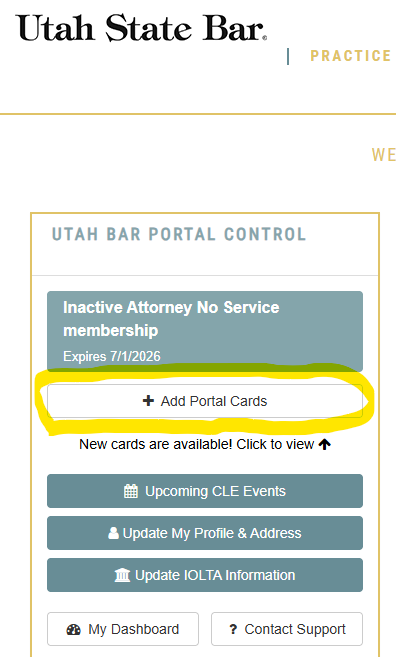
Lexis+ AI is only one of many benefits available through the Bar. Attorneys who have not yet explored the free AI resource page are encouraged to add the card on their Practice Portals to explore the full range of resources and support available or to reach out with questions about joining.

As the legal profession continues to evolve, the Bar remains committed to equipping its licensees with the tools and insights needed to thrive today and in the years ahead. If you decide that Lexis+ AI is right for you, you’ll get a 15% discount for being a Bar licensee. Don’t forget you also have free access to Decisis! Nearly 2,500 Utah lawyers are using the free research platform, which is focused on core primary law (cases, statutes) with a simple interface and strong citator. It is also available on your Practice Portal.

RELATED: Decisis is the New Free Legal Research Tool for Active Utah State Bar Lawyers


Subject-matter inspiration informed by industry analysis authored by Pamela Langham. This article is an original work and does not reproduce her language or structure.

Protecting the Courts, Protecting the Public: The Meaning Behind Utahโ€™s Attorney Oath

By Kim Cordova
Utah State Bar President

Every community depends on the rule of law, whether it is ensuring a teacher is treated fairly in the workplace, a family navigating a custody dispute, or a small business owner working to resolve a financial disagreement. Behind every legal right stands a lawyer sworn by an oath to protect it. This oath, administered by the Clerk of the Court at the Utah Supreme Court, is not simply a formality or procedural step. It is a public promise to uphold the standards and values that maintain trust in our legal system and ensure fairness for everyone.

Kim Cordova, Utah State Bar Presidednt

The Utah State Barโ€™s decision to record a video of the attorney oath serves as a public reaffirmation that the Bar is not a private membership organization but an arm of the court whose purpose is to support and strengthen the judiciary.

By capturing legal professionals repeating the oath on camera, the Bar demonstrates its collective commitment to the rule of law, the integrity of the justice system, and the duty to act in service to the public rather than personal or political interests. The oath is not simply a requirement of licensure but a continuing promise to uphold honesty, professionalism, civility, and constitutional principles in every legal matter that reaches Utahโ€™s courts.

In the words of the Barโ€™s oath-video script, โ€œEvery right we hold to speak, to vote, to be treated fairly depends on one thing: the law being upheld by those sworn to protect it,โ€ and the closing reminder, โ€œThe oath we take is a promise we keep,โ€ captures why recording and sharing the oath publicly strengthens trust between the legal profession, the courts, and the people of Utah.

The official wording of the oath makes the responsibilities clear. It reads,
โ€œI do solemnly swear that I will support, obey and defend the Constitution of the United States and the Constitution of Utah; that I will discharge the duties of attorney and counselor at law as an officer of the courts with honesty, fidelity, professionalism, and civility; and that I will faithfully observe the Rules of Professional Conduct and the Standards of Professionalism and Civility promulgated by the Supreme Court of the State of Utah.โ€ This single paragraph contains several promises that define the professional identity of every Utah legal practitioner.

The first commitment, โ€œsupport, obey and defend the Constitution,โ€ places a legal professionalโ€™s loyalty not with a particular client, agency, or judge, but with constitutional principles. This means that attorneys are bound to protect individual rights, due process, and the foundational structure of our democracy. They act as guardians of fairness, even in cases that are difficult, controversial, or not publicly popular.

The second promise, to discharge their duties with honesty, fidelity, professionalism, and civility, establishes the ethical tone of the profession. Attorneys are expected to be truthful in their communications with clients and the courts, remain loyal to their professional commitments, and conduct themselves with respect toward opposing counsel and all other participants in the legal process. Although the public sometimes views legal disputes as personal battles, the oath reinforces that professionalism and civility are required at all times.

The third promise, to faithfully observe the Rules of Professional Conduct and the Standards of Professionalism and Civility, emphasizes accountability. These rules are not suggestions, and they apply even when no one is watching. Practitioners are obligated to protect clients from conflicts of interest, maintain confidentiality, provide competent legal work, and avoid actions that erode confidence in the justice system. When legal professionals choose to follow both the letter and spirit of these rules, they reinforce public trust in the legal system as a place where people can be heard and treated fairly.

The oath also represents a commitment that continues throughout a legal professionalโ€™s career rather than ending the day it is spoken. Lawyers uphold their oath when they advocate for clients with honesty, when they seek solutions rather than conflict for its own sake, when they show dignity toward others even during heated disputes, and when they support legal access for those who might otherwise be unheard. The closing message in the Utah Bar oath-video script captures this idea by stating, โ€œThe oath we take is a promise we keep.โ€

Ultimately, the oath matters to every Utahn because when legal professionals honor it, families, children, workers, and businesses receive fair treatment. Due process is respected, the innocent are protected, those facing accusations receive a fair opportunity to be heard, and individual freedoms remain secure. The law protects the people, and legal professionals protect the law through their oath.

Changes to Dependent Mental Health Coverage Supporting the Practice of Law

The Utah State Bar is committed to supporting the well-being of its licensees as they navigate the unique demands of the legal profession. Mental health plays a critical role in a lawyerโ€™s ability to practice competently, ethically, and effectively, and access to meaningful support remains a priority for the Bar.

As part of this commitment, the Bar has continued to offer six free mental health sessions through Tava Health to active lawyers, Licensed Paralegal Practitioners (LPPS), and members of the Paralegal Division. This benefit is designed to support licensees in the United States directly in managing the stresses and professional responsibilities inherent in the practice of law.

However, effective February 1, mental health services for inactive licensees and dependentsโ€”including children and other family membersโ€”will no longer be available through the Tava Health program (with the exception of couples therapy). While this was not an easy decision, it reflects the increasing cost of providing dependent coverage and the Barโ€™s responsibility to ensure that its limited resources remain focused on benefits that directly support licensees in their professional roles.

We recognize that the mental health of family members can significantly affect a lawyerโ€™s ability to focus, perform, and maintain well-being in the practice of law. For that reason, the Bar encourages self-pay, the use of private insurance, or alternative resources that may help fill in the gap for families seeking support.

Utah-Based Mental Health Resources

Families may consider the following Utah-based providers and tools:

  • Mindless Labs โ€“ Free app of mental health support and digital tools
  • Healthy Mind Map โ€“ A digital support tool designed to complement therapy and promote engagement between sessions
  • Infinite Mind โ€“ An app focused on improving cognitive performance through evidence-based exercises

These programs generally provide therapy as part of training for advanced counseling students, supervised by licensed clinicians:

National and Online Resources

Families may also find support through the following organizations and platforms, many of which offer free education, tools, or reduced-cost services:

  • ElizaChat – An AI-powered mental health companion guided by licensed professionals (not a substitute for therapy)
  • The Trevor Project – Crisis intervention and suicide prevention services for LGBTQ+ individuals

The Bar understands that changes to benefits, particularly those affecting families, can be difficult. While dependent coverage through Tava Health will no longer be available, the Bar remains committed to transparency, responsible stewardship of resources, and supporting licensees in maintaining the mental and emotional health necessary for the practice of law.

If you have questions regarding this change or need assistance locating resources, please do not hesitate to reach out. You may contact Executive Director Elizabeth Wright at elizabeth.wright@utahbar.org. For more information or to enroll in Tava Health, click here.

Utah Judiciary launches new Veterans Court to support former service members in the justice system

PRESS RELEASE

Ogden, Utahย (Dec. 29, 2025) โ€” The Utah State Courts will officially launch a new Veterans Court in the Second District Court on January 5, 2026. Veterans Court is a specialized program designed to support military veterans who become involved in the criminal justice system. It will serve residents of Weber, Davis, and Morgan counties.

Veterans Court is a problem-solving court that connects eligible veterans with treatment, mentoring, and support services while holding participants accountable through close judicial supervision. The program recognizes that some veterans face unique challenges related to military service, including post-traumatic stress, substance use disorders, and difficulties transitioning to civilian life.

Please join us for a news conference launching the start of Veterans Court in the Second District:

Who:

Gov. Spencer Cox

Jennie Taylor, Veterans Advocate and Gold Star Widow

Judge Craig Hall, 2nd District Court Judge

When:

Monday, January 5

10:00 a.m.

Where:

Ogden Second District Court

Courtroom 2D

2525 Grant Avenue, Ogden

The news conference will be followed by a reception. Media are invited to attend and speak with officials and possibly former participants about how Veterans Court works and the benefits it brings to Second District.

โ€œThis court is about accountability, treatment, and dignity,โ€ said Judge Craig Hall. โ€œVeterans Court allows us to address the underlying issues that may bring veterans into the justice system, while also honoring their service and helping them move forward in a productive way.โ€

Participants who qualify for Veterans Court will engage in a structured program that may include mental health treatment, substance abuse counseling, regular court appearances, and mentorship from fellow veterans. Successful completion can result in reduced charges or alternative sentencing, depending on the case.

Veterans Court programs already operate successfully in Utahโ€™s Third and Fourth Districts but expanding the program to the Second District is especially important given the proximity to Hill Air Force Base and the significant veteran population it serves.

# # #

Tania Mashburn
She/Her/Hers
Director of Communications
801-712-4545taniam@utcourts.gov

Streamlining Utah Practice: How to Set Up Your E-Filing and xChange Accounts

Efficient interaction with Utahโ€™s courts depends on two core systems used by attorneys: eFlex for electronic filing and service, and xChange for accessing statewide court records. These systems support filings in Utahโ€™s district courts, justice courts, and appellate courts, as well as e-filing services provided through the Utah State Bar.

Although both systems are documented on the Utah Courts website, the Utah State Bar continues to receive frequent questions from practitioners about how to get started. The following quick-start checklists summarize the essential steps so Bar licensees can establish access and begin filing without delay.

E-Filing Account Setup: Quick Steps for Attorneys

Utah attorneys file documents electronically through certified Electronic Filing Service Providers (EFSPs). The primary EFSP used by attorneys statewide is eFlex, developed and maintained by Tybera. eFlex is the system used for attorney e-filing in Utah trial courts and appellate courts and is also the platform through which the Utah State Bar provides e-filing services.

Utah State Bar eFiling Portal

eFlex functions as a full-service attorney e-filing and service platform, allowing licensed attorneys and authorized staff to submit pleadings, motions, and other documents; receive court notices and filings; manage payment of filing fees; and track submission status across cases.

To get started using eFlex:

  • Navigate to the eFlex website through the Utah Courts or Utah State Bar e-Filing pages.
  • Select Create an Attorney Account. You will need:
    • Your Utah Bar number
    • A valid email address associated with your licensing records
    • Firm and contact information
  • Complete identity verification and accept the required user agreements.
  • Add a payment method (credit card or ACH) for filing fees and service charges.
  • If you work with multiple firms or file in different capacities, confirm that your firm affiliations and contact details are correctly configured before submitting filings.
  • Review e-filing training materials and confirm that all PDF documents meet Utah Courtsโ€™ technical requirements, including proper formatting, file size limits, and Optical Character Recognition (OCR).
  • If documents are scanned, OCR must be applied using PDF software (such as Adobe Acrobat or equivalent) before uploading them into eFlex.

Once your account is approved, you may submit filings electronically to Utah district courts, justice courts, and appellate courts, as applicable, and receive service and notices through the system.

About Certified Electronic Filing Service Providers (EFSPs)

Utahโ€™s e-filing system operates under a multi-vendor certification model. EFSPs act as intermediaries between filers and the courts by routing documents to the courtsโ€™ e-filing system and providing workflow, service, and payment tools commonly used by attorneys.

Certified EFSPs approved for Utah courts include Tybera (eFlex), GreenFiling, Judicialink, LLC, and COURTPATH. Each provider offers its own interface and pricing structure. Attorneys may choose the provider that best aligns with their practice needs; however, eFlex by Tybera is the primary system used by the Utah State Bar and is widely adopted across Utah courts.

xChange Account Setup: Quick Steps for Attorneys

xChange is the Utah Courtsโ€™ secure, subscription-based system for accessing statewide district and justice court case information. It provides real-time access to docket activity, filings, party information, hearing dates, and case histories, making it an essential research and case-management tool for attorneys.

Practitioners use xChange to monitor their own cases, conduct conflict checks, verify case status, track opposing counsel activity, and prepare for hearings with current and accurate docket data.

To set up an xChange account:

  • Visit the Utah Courts xChange login page.
  • Select Set Up a New xChange Account.
  • Register using your Utah Bar number and the email address associated with your attorney licensing records.
  • Choose a billing option (monthly subscription or per-search billing).
  • Complete and submit the required licensing and user agreement forms electronically.
  • Once approved, log in to begin searching statewide district and justice court records.

Utah Courts xChange login page

Effective use of xChange supports accurate filings, reduces administrative delays, and strengthens strategic case management across Utahโ€™s courts.

Together, e-filing and xChange create a unified workflow: e-Filing ensures your pleadings and motions are submitted accurately and on time, while xChange provides immediate visibility into docket activity, judicial orders, case statuses, and upcoming hearings. This dual-access model reduces administrative friction, minimizes the risk of missed deadlines or unnoticed filings, and enables more informed decision-making throughout the life of a case.

How e-Filing and xChange Work Together

Together, eFlex and xChange create a unified attorney workflow. e-Filing through eFlex ensures pleadings and motions are submitted accurately, timely, and in compliance with court rules. xChange provides immediate visibility into docket activity, judicial orders, case statuses, and upcoming hearings.

This dual-system approach minimizes the risk of missed deadlines or unnoticed filings, reduces administrative friction, and enables more informed decision-making throughout the life of a case.

Where to Go for Help

The Utah State Bar cannot provide technical support for court-managed systems or third-party EFSP platforms.

  • E-Filing Issues:
    • Contact your Electronic Filing Service Provider (EFSP) directly.
    • For court-specific filing questions, contact an e-Filing Specialist in the district where you are filing.
    • For justice court filings, contact the justice court directly.
  • Data Correction Requests:
    • Requests to correct errors in e-filed information (such as misspelled party names or incorrect judgment amounts) must be submitted in PDF or Word format, following court instructions.
  • General Court Procedural Questions:
    • Administrative Office of the Courts: 801-578-3800

xChange Support

For assistance with xChange access, subscriptions, or technical issues, email courtsystems@utcourts.gov

Court Self-Help and General Court Process Assistance

  • Utah Courts Self-Help Center: 1-888-683-0009
    (Not attorney-specific, but helpful for general procedural questions)
  • Local Court Clerk Contacts:
    Use the Utah Courts interactive map to locate judicial districts or courthouses and access contact information and administrative resources.
  • Utah State Courts Forms Hotline: 801-238-7990
    Court forms are also available through the Utah Courts website.

Top of Form

Bottom of Form

*AI assisted with the content for this blog. Please email communications@utahbar.org with missing or corrected information.

Effective Client Communication Is All About Details and Documentation

By Mark Bassingthwaihte, Esq.

ย ย ย ย ย ย ย ย ย ย ย ย ย  ABA Model Rule 1.4 Communication seems clear on its face. Attorneys are to keep clients reasonably informed about the status of their matters as well as to promptly comply with reasonable requests for information. Attorneys are to also explain a matter to the extent reasonably necessary to permit all clients to make informed decisions regarding their representation. Maybe Iโ€™m just not seeing it, but all this seems rather straightforward to me. If it were that simple, however, why do attorneys continue to face disciplinary complaints and malpractice claims in the numbers they do for simply failing to communicate? I believe, in part, itโ€™s because many donโ€™t fully understand what the rule is saying.

              I have found it helpful to analyze Rule 1.4 from a slightly different perspective than whatโ€™s commonly done, which is to take it at face value and focus on what needs to be communicated and when. Weโ€™re often told of the importance of returning phone calls in a timely fashion, forwarding copies of all relevant documents, providing regular and detailed billing, and personally visiting with the client to explain the status of a matter sufficient to allow the client to make informed decisions when deemed necessary. While important, I would like to come at the rule from the perspective of who gets to decide what.

              Beyond what is set forth above, Rule 1.4 also states that an attorney shall inform the client of any decision or circumstance that requires the clientโ€™s informed consent under the Rules. This brings Rule 1.2 Scope of Representation and the conflict rules into play. In addition, the Rule 1.4 tells us that an attorney is to reasonably consult with the client about the means by which the clientโ€™s objectives are to be accomplished. For me, this language shifts the emphasis of the rule. Rule 1.4 isnโ€™t just about what an attorney thinks a client needs to know. Itโ€™s also stating that an attorney is to communicate all that a client reasonably expects to be told throughout the course of representation. There is real value in shifting the focus from what an attorney thinks should be shared and moving it toward what a client would reasonably expect his or her attorney to share. 

              With this in mind, what are the ramifications of Rule 1.4 day to day? Certainly, promptly returning phones calls, timely responding to client requests for information, forwarding copies of documents, and the regular sending of detailed bills are a given. But there is more. An attorney should keep clients informed of all court dates, all filings, and all offers to settle or mediate. Also, donโ€™t overlook telling clients about any changes to your contact information such as a change in your address, phone number, or email. Yes, perhaps a shift in perspective wasnโ€™t necessary to develop this list thus far; but I will share that many attorneys regularly struggle with following through on just these basics.

              Typical rationalizations or excuses include the client doesnโ€™t really need to be bothered with this, I know what my client will say or decide anyway, I donโ€™t have the time to tell them, the client doesnโ€™t want to be billed for the time it will take, etc. In short, attorneys start to run with assumptions and rationalizations when it comes to the basics of effective communication. This can be a dangerous play.

              How could the above list of suggested communication best practices be expanded? Consider scope of representation. An attorney hired to handle litigation for a financial institution will understandably want to focus solely on the litigation. On the other hand, the client who has hired this attorney may be expecting the attorney to see the โ€œbig pictureโ€ and keep them informed about everything in play, to include issue spotting. What if there is a regulatory reporting and/or compliance issue peripheral to the litigation? If the attorney is not up to handling the related issue, she must say so because the client will often reasonably expect their attorney to not only issue spot, but to take care of the related matter or at least inform them of anything the attorney is not competent to or perhaps prepared to handle so that appropriate attention can be given to that peripheral issue. This is one reason why documenting scope of representation is critically important with all clients. Again, it is all about considering what clients would reasonably expect to be told.

              So, now we can expand our list of ramifications to include the following. Clients should be told what the scope of representation is and also what it isnโ€™t. They should be informed of their rights, especially in criminal matters. The ramifications of any actual or potential conflict issues should be fully explained prior to any client agreeing to representation. Client permission should be sought and obtained for granting extensions of time to adverse parties, stipulating to evidence or testimony, agreeing to continuances, and for making and/or rejecting any and all settlement offers. Clients expect to be told when their matter has concluded and what, if anything, they must yet do. And whether through inability or oversight, clients must also be informed of a failure to act on the clientโ€™s matter or that their case has been dismissed. Clients do reasonably expect to be informed about any and all of the above regardless of whether itโ€™s good news or bad.

              This shift in perspective helps keep the emphasis on the expectations of your clients. Remember it is you who is in their employ, and they are the ones who get to make many of the important decisions. This reality does not in any way, shape or form minimize your role as the attorney. In fact, I believe this perspective helps to elevate your role. Consider the word โ€œcounselorโ€ in light of Rule 1.4 and ask yourself what might that word mean in daily practice? For me, it means an attorney is to advise the client about the legal and practical aspects of any given matter. She is to identify and evaluate alternative solutions, pointing out the positive and negatives of each. The goal is to enable the client โ€œโ€ฆto participate intelligently in decisions concerning the objectives of the representation and the means by which they are to be pursued.โ€ (See Comment 5 to Rule 1.4 of the ABA Model Rules.)

              This intended outcome does require you to approach communication from the clientโ€™s perspective. What clients expect to be told will vary with every client and every matter. Talk to your clients and try to determine their expectations from the outset. Ask yourself โ€œwhat does the client need to know to be able to make intelligent decisions.โ€ The bottom line is clients do expect to be fully informed, and attorneys have an ethical obligation to meet that expectation. Hereโ€™s the kicker, however. Your communication efforts must be handled in a way that seeks to ensure that the client understands and comprehends all that is being communicated about all that must be decided. Forwarding copies just doesnโ€™t cut it.

              Of course, all of your communication efforts may be for naught if there is no contemporaneously made documentation of what was communicated by both you and your clients. Of particular importance is documenting any and all advice given, coupled with creating a record of the decision-making process. Note what information was shared with you that you based your advice upon and detail why you gave the advice you gave.  Also make sure you document what the clientโ€™s reasons were for making any decision made, especially if the decision was not entirely in line with the advice you gave.

              Iโ€™ve heard all kinds of excuses for why attorneys fail to follow through with thoroughly documenting all files along these lines.  โ€œIt isnโ€™t necessary,โ€ โ€œIt takes too much time,โ€ โ€œThere are too many other things we have to do,โ€ โ€œThe client would be offended if we did that,โ€ and โ€œWeโ€™re trying to keep costs downโ€ are commonly shared. Just remember thatโ€™s all well and good until someone questions what you did or why you did it. Memories are short, yours included. Never forget the following. If you didnโ€™t document it, it wasnโ€™t said, or it didnโ€™t happen. Thatโ€™s how it often plays out in the world of discipline and malpractice.

Mark Bassingthwaighte, Esq. Is the resident Risk Manager at ALPS Insurance. To learn more about how ALPS can support your solo or small firm visit: alpsinsurance.com

Search UtahBar.org