

Many people hear “State Bar” and think of lawyers, courtrooms, and legal licensing. However, the Utah State Bar serves a much broader purpose. It supports Utah families by helping them access legal services, learn about their rights, protect themselves from dishonest conduct, and address concerns if something goes wrong. Across the state, the Bar works to ensure that the legal system is accessible, trustworthy, and understandable for everyone, regardless of income or background.
When appropriate, the Bar also advocates for a strong and independent judiciary because public protection depends on a court system that is fair, impartial, and free from political or financial influence. When judges can make decisions based solely on the law and the facts, without pressure from outside interests, individuals and families receive equal treatment and predictable justice. The Bar supports policies and public education efforts that reinforce the separation of powers, promote judicial integrity, and ensure that courts remain accessible and accountable. By prioritizing judicial independence, the Bar helps safeguard the rights of all Utahns and reinforces confidence in the courts.
Protecting the integrity of the courts is only one part of the Bar’s work to support the public. It also focuses on making sure people can engage with the legal system in practical ways, especially when they are facing challenging life circumstances.
Improving Access to Justice: Legal Help When It Matters Most
Legal issues can affect housing, family stability, employment, finances, and many other areas of life. Unfortunately, some families hesitate to seek legal help because they assume it is too expensive or complicated. The Bar provides alternatives so people can get legal assistance that fits their needs and their budget.
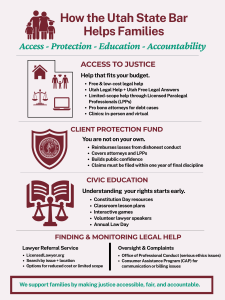
Programs and initiatives include:
-
- The Bar’s Access to Justice Office provides education and resources for families that qualify for reduced fees, which can be accessed at Utah Legal Help. One particular service offered is limited-scope legal representation under the Pro Se Debt Collection Calendar. Pro bono attorneys represent individuals in need of assistance with debt collection matters. Many of these people appear at their initial hearings self-represented, with little to no understanding of how to defend themselves or their rights. This lack of knowledge frequently leads to default judgments and increased debt amounts. The Access to Justice Office manages this program closely with the courts to ensure these individuals have the opportunity to consult with an attorney, gain clarity about their legal rights, and have a better understanding of their situations.
-
Free and low-cost legal clinics, both in person and virtual. A specific online service is called Utah Free Legal Answers. This program is a virtual legal advice clinic in which qualifying users submit civil legal questions at no cost to be answered by pro bono attorneys.
Question topics include:
- Family, Divorce, Custody,
- Housing, Eviction, Homelessness,
- Consumer Rights, Financial, Work, Employment, Unemployment,
- Health and Disability, Income Maintenance,
- Civil Rights,
- Juvenile and Education Law.
Services that offer brief legal advice for people who do not need full representation, such as Licensed Paralegal Professionals (LPP). An LPP can help with certain family law matters (such as temporary separation, divorce, parentage, cohabitant abuse, civil stalking, custody and support, or name changes). They can also assist with landlord/tenant situations involving forcible entry and detainer, and debt collection matters in which the dollar amount at issue does not exceed the statutory limit for small claims cases.
Because LPPs are not lawyers, they cannot represent you by making arguments to the judge in court. They can help you complete legal forms, review documents, participate in mediation negotiations, prepare settlement agreements, and explain court orders for less than you would pay a lawyer.
The Young Lawyers Division of the Bar sponsors service projects, which include free legal help to various populations. In particular, the division presents Wills for Heroes with estate planning, living wills, and healthcare and financial powers of attorney to first responders (police, firefighters, paramedics, etc.) and their spouses or partners.
These one-day events take place five times a year throughout the state of Utah at a first responder department or community center. Participants are trained and provided with laptop computers that have been preloaded with specialized software that allows volunteer attorneys to take questionnaire information previously completed by the individual and input it to create the legal documents.
These resources support individuals dealing with issues such as divorce, custody, landlord and tenant disputes, consumer problems, and other civil matters. The focus is on making justice available to families at every income level.
However, while improving access to justice is essential, access alone is not enough. Families also need assurance that when they place their trust in a legal professional, that trust will be honored. For that reason, the Bar has systems in place to protect clients if misconduct occurs.
Client Protection Fund: A Safety Net for Victims of Dishonest Conduct
The Utah Supreme Court established the Fund for Client Protection on April 9, 1977, to provide meaningful cost reimbursement to people in the rare cases where a lawyer or LPP mishandled funds or engaged in dishonest conduct.
The fund is designed to:
-
- Compensate clients when losses occur due to a legal practitioner’s dishonest actions
-
- Promote and preserve public confidence in the legal profession
-
- Safeguard individuals who may already be facing stress and difficulty during a legal matter
A claim to the Fund for a loss must meet the following criteria:
-
- The loss must be caused by the dishonest conduct of the lawyer or the LPP;
-
- The loss must have arisen out of the course of a lawyer/client, LPP/client, or fiduciary relationship between the lawyer or the LPP and the claimant and by reason of that relationship; and
-
- The claim to the Fund must be filed within one year after the date of the final order of discipline, the date of death, or the date of the order of disability.
This program reflects the Bar’s dedication to protecting the public as well as regulating the legal community. But safeguarding the public is not limited to oversight and complaint resolution. The Bar also strives to strengthen civic knowledge, so Utahns have the tools to participate confidently in their communities and in the legal system.
Civic and Constitutional Education: Learning About Rights and Responsibilities
Supporting civic education for Utah families is something the Bar takes seriously. One example is the Constitution Day webpage, which provides educational tools that introduce constitutional principles in engaging and age-appropriate ways.
Families and educators can access:
-
- A downloadable copy of the United States Constitution
-
- Interactive educational games suitable for children and families
-
- Classroom lesson plans and activities for teachers and homeschool settings
-
- Opportunities to invite volunteer lawyers to speak with students about the Constitution and the legal system
The Bar also celebrates Law Day to highlight the rule of law and public understanding of legal rights, government, and justice. These resources help children and adults understand their rights and responsibilities, and how the law affects everyday life.
While civic education lays a strong foundation, families also need support when a legal issue becomes real rather than theoretical. That is why the Bar offers services that guide people from learning about their rights to finding legal professional assistance.
Lawyer Referral Services: Finding the Right Legal Help
When families need an attorney or an LPP, the hardest part is often knowing where to begin. The Bar makes the search easier with LicensedLawyer.org, which connects individuals to licensed professionals based on the type of legal issue, location, and financial situation.
Ethics rules prohibit the Bar from recommending specific attorneys or offering legal advice, but through the referral website, families can:
-
- Search for legal professionals by practice area
-
- Request help from lawyers who provide limited scope services for those who need assistance with only part of a case
-
- Locate practitioners who are open to reduced cost arrangements or alternative payment options
These referral services provide confidence that the lawyer or paralegal practitioner selected is qualified, licensed, and accountable to professional standards. Guiding the public to reputable lawyers is an important step in protecting clients, but equally important is monitoring professional conduct to ensure those lawyers continue to meet ethical and professional expectations.
Office of Professional Conduct: Oversight and Accountability
A healthy legal system depends on strong professional standards. The Bar maintains oversight through two important functions that support the public.
-
- The Office of Professional Conduct investigates allegations of serious ethical violations by attorneys or LPPs. The staff thoroughly works to protect the integrity of the profession by prosecuting, where necessary, those individuals who have not satisfied their professional ethical obligations. Additionally, OPC educates licensees of the Bar regarding their professional ethical responsibilities through seminars and discipline notices in the
Utah Bar Journal.
- The Office of Professional Conduct investigates allegations of serious ethical violations by attorneys or LPPs. The staff thoroughly works to protect the integrity of the profession by prosecuting, where necessary, those individuals who have not satisfied their professional ethical obligations. Additionally, OPC educates licensees of the Bar regarding their professional ethical responsibilities through seminars and discipline notices in the
-
- The Consumer Assistance Program (CAP) provides help with less serious issues such as communication problems, billing disputes, or difficulty obtaining documents or case information. For instance, CAP may be able to help a consumer get their file, locate their attorney or LPP, resolve a communication problem, and provide some general information about the legal system. CAP can also provide information about lawyers and LPP ethical obligations to the consumer and provide referrals to other resources and agencies.
These resources give families a clear path to address concerns and ensure that legal professionals remain accountable to the standards of their profession. In fact, each resource offered by the Bar fulfills a specific role, but together they form a larger network of support for the community.
What This Means for Utah Families
This comprehensive approach underscores the Bar’s dedication to protecting the public and strengthening trust in the justice system. Whether someone is navigating a difficult legal matter, planning for the future, seeking help for a child’s school project, or simply looking for trustworthy legal advice, the Bar offers programs that are designed to serve the public.
Families benefit because:
-
- Legal help is available regardless of income
-
- Clients are protected if a legal professional acts dishonestly
-
- Children and adults have access to high-quality civic and constitutional learning resources
-
- People can find licensed legal professionals they can trust
-
- There are systems in place to investigate concerns and resolve complaints
The Bar is not only an organization that supports attorneys. It is a resource for Utah families and communities. It promotes access to justice, strengthens public trust, and helps make the legal system understandable and fair for everyone.