
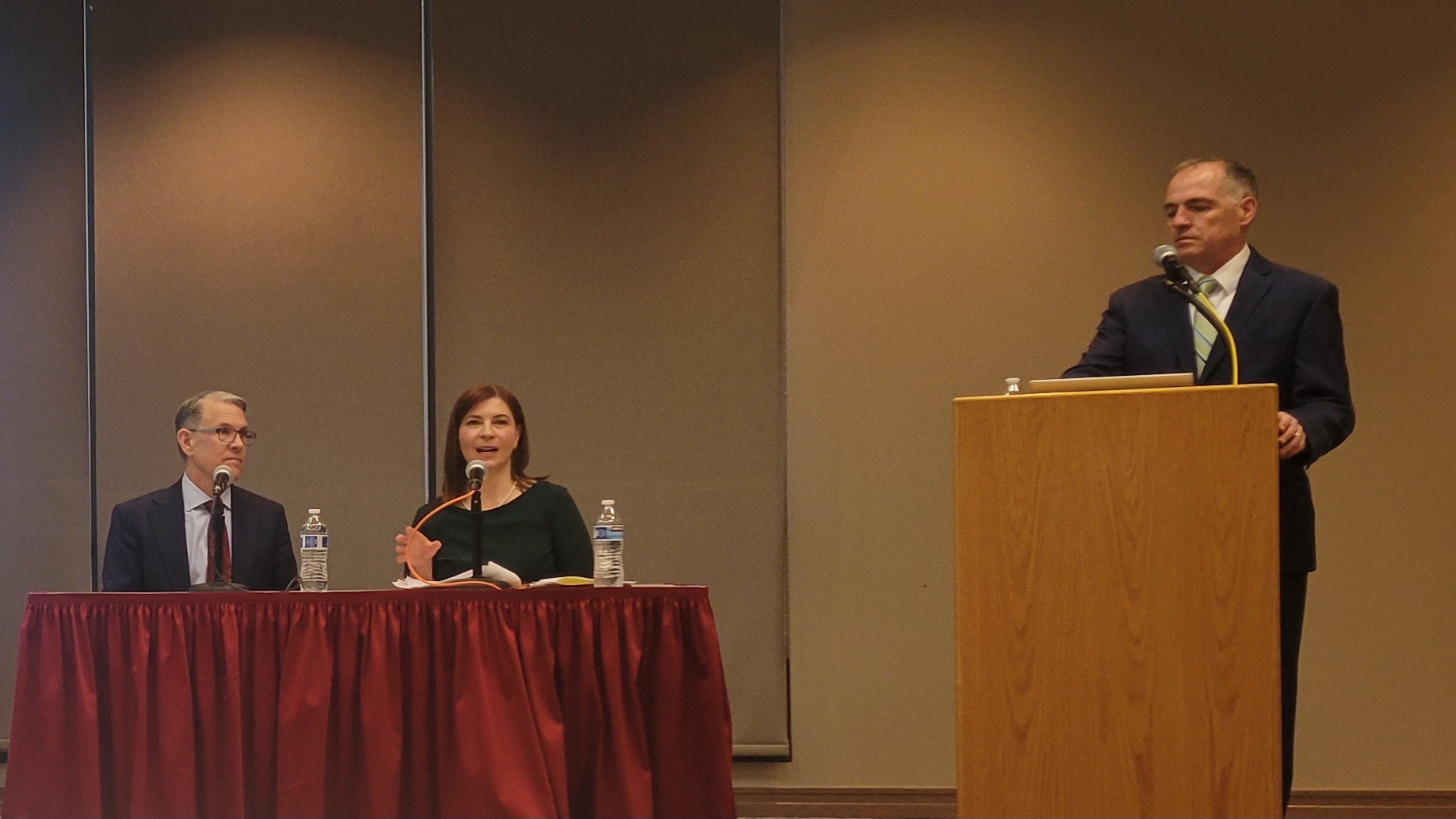
At Part 2 of the Utah State Bar’s “Let’s Talk, Let’s Listen” CLE series, attorneys and judges gathered in person and online for a timely conversation about the judiciary, legislative power, and the balance between the branches of government.
Moderated by Keith A. Call of Spencer Fane, the event on March 17, 2026, drew strong interest, with roughly 850 attendees registered on Zoom and about 50 people attending live at the Utah Law & Justice Center. The discussion featured Utah Supreme Court Justice Paige Peterson and Utah Court Administrator Ron Gordon, who offered insight into how recent legislative activity is affecting Utah courts and why judicial independence remains essential.
A high-interest moment for Utah’s legal community
Call opened by noting the extraordinary level of attention surrounding the relationship between Utah’s judicial and legislative branches. He pointed to a recent legislative session that included an unusually large number of bills affecting the courts, the judiciary, and the legal profession.
The purpose of the event, he said, was to move beyond slogans and headlines and instead create a meaningful discussion about checks and balances, separation of powers, and the appropriate role of each branch of government.
What does the Utah Court Administrator do?
Gordon began by explaining his role as Utah’s court administrator. By statute, he oversees the administrative operations of the judiciary, but he does not direct judges or influence judicial decision-making.
That distinction, he emphasized, is critical.
Judges decide cases. His role is to support the system that enables courts to function, including staffing, operations, and coordination with the Utah Judicial Council, one of the two constitutional governing bodies of the judiciary, along with the Utah Supreme Court.
Justice Peterson on the redistricting ruling and public criticism
One of the central topics was the Utah Supreme Court’s opinion in League of Women Voters of Utah v. Utah State Legislature, the redistricting case that has drawn sharp criticism from some lawmakers.
Justice Peterson acknowledged the criticism directly. She said public criticism comes with public office, and judges understand that their decisions will be scrutinized. But she also expressed frustration that much of the public debate has not focused on what the court actually held.
“I wish the criticism in this specific instance were more directed at the legal issues we actually answered,” Peterson said. “A lot of it isn’t really focused on what we actually said in the opinion.”
She then walked through the legal question at the center of the case.
The dispute arose after voters approved Proposition 4, a citizen initiative aimed at prohibiting partisan gerrymandering in redistricting. After its passage, the legislature repealed the initiative, replaced it with a different law, and later enacted a congressional map that plaintiffs argued amounted to partisan gerrymandering.
According to Peterson, the plaintiffs argued that the legislature’s actions violated two provisions of the Utah Constitution: the initiative power and Article I, Section 2, which states that all political power is inherent in the people and that they have the right to alter or reform their government as the public welfare may require.
Peterson said the legal question before the Court was narrow and specific. “That was the question before us,” she said. “Is this an enforceable right? Does this right get constitutional protection? Or is it the case that the legislature can repeal any citizen initiative without limitation, even if it reforms the government, because they have legislative power which allows them to do that?”
The Court’s answer, she said, was equally specific.
“What we said is this is in our declaration of rights. It says what it says. It is an enforceable right,” Peterson said. “If one thinks, if the people of Utah think that the legislature has violated it, they can come to court and get a hearing on that. And this is a cognizable claim that you can bring to court. That is what we held.”
She also pushed back on the claim that the opinion created something new or extraordinary.
“I don’t think that creates a superlaw,” Peterson said. “This is not anything new.”
And she emphasized that the Court was not making policy. “We don’t create the law,” she said. “We look at the law as it exists. We interpret it and we apply it in controversies that are brought before us. And that’s what we did in this case.”
Her broader point was that the public argument over Proposition 4 should center on the Court’s actual reasoning, not political shorthand. “I would love for the debate to focus on that,” she said.
The legislative session’s practical impact on the courts
Gordon highlighted several major developments from the legislative session, beginning with Senate Bill 134, which added seven new judgeships. That included two additional Utah Supreme Court justices, two new Court of Appeals judges, and three new district court judges.
He described the expansion as historic.
The judiciary had requested additional district court, juvenile court, and Court of Appeals judges, and Gordon said those additions were badly needed. He also noted the practical consequences: more judicial chambers, more staff, and even physical construction to make room for the expanded bench.
He also pointed to legislation creating new procedures for certain constitutional claims against state actors, including the possibility of three-judge district court panels. That change, he explained, has major administrative consequences because cases that previously required one judge may now require three judges and additional support staff.
Other measures, including broader judiciary amendments, are also changing how case assignments work and how judicial resources are allocated.
What are the proper checks on the judiciary?
When asked about appropriate checks on judicial power, Justice Peterson turned to a foundational principle: the judiciary is often described as the “least dangerous branch” because it does not control the purse or the sword.
The executive branch enforces the law. The legislative branch controls public funding and policymaking. The judiciary’s role is different. Its responsibility is to interpret the law, apply it in actual controversies, and exercise judicial review when a party argues that another branch has exceeded constitutional limits.
That is not activism, she said. It is the judiciary’s core constitutional duty.
Peterson also emphasized that the judiciary already operates under significant checks. The legislature controls judicial funding. The political branches influence judicial selection. The legislature has changed who selects the chief justice. And the judiciary depends on the executive branch to enforce some court orders.
What the judiciary must preserve, she argued, is the ability to decide cases based only on law, without fear or favor. That independence is not for judges’ benefit. It exists so that every person who comes to court can trust they will get a fair hearing, even when the opposing party is the government itself.
The state of judicial independence in Utah
Peterson described the current moment as “a bit of a rocky time,” citing unusually direct criticism of judges, calls for impeachment, and legislative condemnations of the Court and individual jurists.
Even so, she pushed back on the idea that the Utah Supreme Court is unchecked.
Unlike the U.S. Constitution, she noted, the Utah Constitution can be amended with relative regularity. If the people of Utah disagree with the Court’s constitutional interpretation, the legislature can propose an amendment and voters can ratify it. In that sense, the Court is not truly the last word.
As for how judges stay independent amid public criticism, Peterson said the answer is straightforward, even if the reality is difficult: judges must continue doing the job as the law requires. She said she does not know any other way to serve.
At the same time, she acknowledged a recurring frustration. Judges generally cannot join public debates to defend or explain themselves beyond their written opinions. When public debate misstates those opinions, judges often have little ability to respond.
How the judiciary works with the legislature
Gordon offered a practical view of how the courts and legislature interact. The Utah Supreme Court and Judicial Council determine the judiciary’s positions on legislation, and court staff communicate those positions during the legislative process.
Much of that interaction, he said, actually works well.
In many cases, legislators listen to judicial concerns, make changes, and address unintended consequences. Gordon was careful not to frame disagreement itself as a problem. If the legislature disagrees with a court’s interpretation of a statute, it can amend that statute. That is part of the normal constitutional process.
The real concern, he said, arises when proposals appear designed not merely to change policy but to influence how judges think about cases. If a judge is pressured to ask anything other than “What does the law require in this case?” then judicial independence is at risk.
Gordon said that standard matters deeply to him, especially after years of watching judicial appointments under Governor Gary Herbert. He recalled that judicial candidates were consistently asked to explain the role of a judge and commit to making not only the easy decisions, but the hard ones as well.
That, he said, is exactly what Utahns should want from their courts.
Why aren’t there more Supreme Court dissents?
Peterson also addressed criticism that the Utah Supreme Court does not issue enough opinions or enough dissents.
On the opinion volume question, she explained that the COVID-19 pandemic disrupted the entire court pipeline. Trial slowdowns in district court eventually affected the Court of Appeals and then the Supreme Court. At the same time, the Court went through a major transition as two justices retired. That combination temporarily reduced output.
She said the Court has since returned to a more typical pace, with around 60 opinions per year.
As for dissents, Peterson said fewer dissents often reflect a rigorous internal process, not a lack of serious disagreement. Draft opinions are circulated among the justices, who critique them intensely. That process often leads to refinements, narrower reasoning, and greater consensus.
In her view, a unanimous opinion shaped by careful debate is often stronger than one fragmented into multiple separate writings.
Why the chief justice selection change matters
Peterson was especially candid about one recent change: the selection of Utah’s chief justice.
Previously, the Supreme Court selected its own chief. Now the governor and legislature play that role. Peterson said that matters because the chief justice is not only the head of the Supreme Court, but also the administrative leader of the judiciary and a key public voice in defending judicial independence.
Putting that position under the control of the political branches, she said, raises real concerns. She compared it to the judiciary selecting the Speaker of the House or the Senate President, an arrangement legislators themselves would almost certainly reject.
Concerns about judicial selection
Peterson also expressed concern about changes to Utah’s judicial selection process.
She described her own experience applying for the bench as a powerful example of Utah’s merit-based system at work. Initially skeptical, she said she came away convinced the process was genuinely rigorous and focused on qualifications, temperament, and integrity rather than political connection.
That, she argued, is something Utahns should value and protect.
She warned that recent changes have weakened key guardrails, including the removal of a rule designed to ensure nominating commissions were not dominated by one political party. She also pointed to proposals that would have gone even further, such as weakening the nominating commission system or moving toward judicial elections.
In her view, those changes would erode public confidence and risk turning judges into politicians.
Her message was clear: merit selection protects the public, not the judiciary alone.
Reasons for optimism
Despite the tension surrounding the topic, both speakers pointed to reasons for hope.
Gordon said there are many healthy interactions between branches of government that never make headlines. Peterson echoed that, noting that legislators and the judiciary often engage constructively, especially when discussing bills that directly affect court operations.
She also highlighted efforts by the courts to improve public engagement, including the judiciary’s Court Connect project, which invites members of the public to courthouses to meet judges and learn how the court system works. That effort, she said, was partly a response to concerns that courts can seem distant or mysterious.
She described it as a positive example of the judiciary listening and responding in good faith.
A call to action for lawyers
In closing, both speakers urged lawyers to remain engaged.
Gordon encouraged attorneys to speak up when they see threats to judicial independence, noting that courts cannot always defend themselves publicly.
Peterson closed on a broader historical note, tying the discussion to the 250th anniversary of the Declaration of Independence. She reminded the audience that many of the colonists’ grievances against King George III involved the denial of an independent judiciary and fair legal process.
For her, that history underscores the enduring importance of judicial independence, not as an abstract ideal, but as a practical safeguard for everyone who depends on the rule of law.
And she left the audience with gratitude: lawyers, she said, have understood what is at stake and have been willing to stand up for those principles.
Final takeaway
The conversation made one point unmistakably clear: this is not just an institutional debate about courts and legislatures. It is a debate about whether Utahns can trust that legal disputes will be decided fairly, impartially, and according to law.
That trust depends on a judiciary strong enough to make difficult decisions and independent enough to make them without fear.
Part I featured Senate President Stuart Adams and Speaker of the House Mike Schultz: https://www.youtube.com/watch?v=_-_Vrag65vo&t=18s
AI was used to summarize this blog of the CLE event.